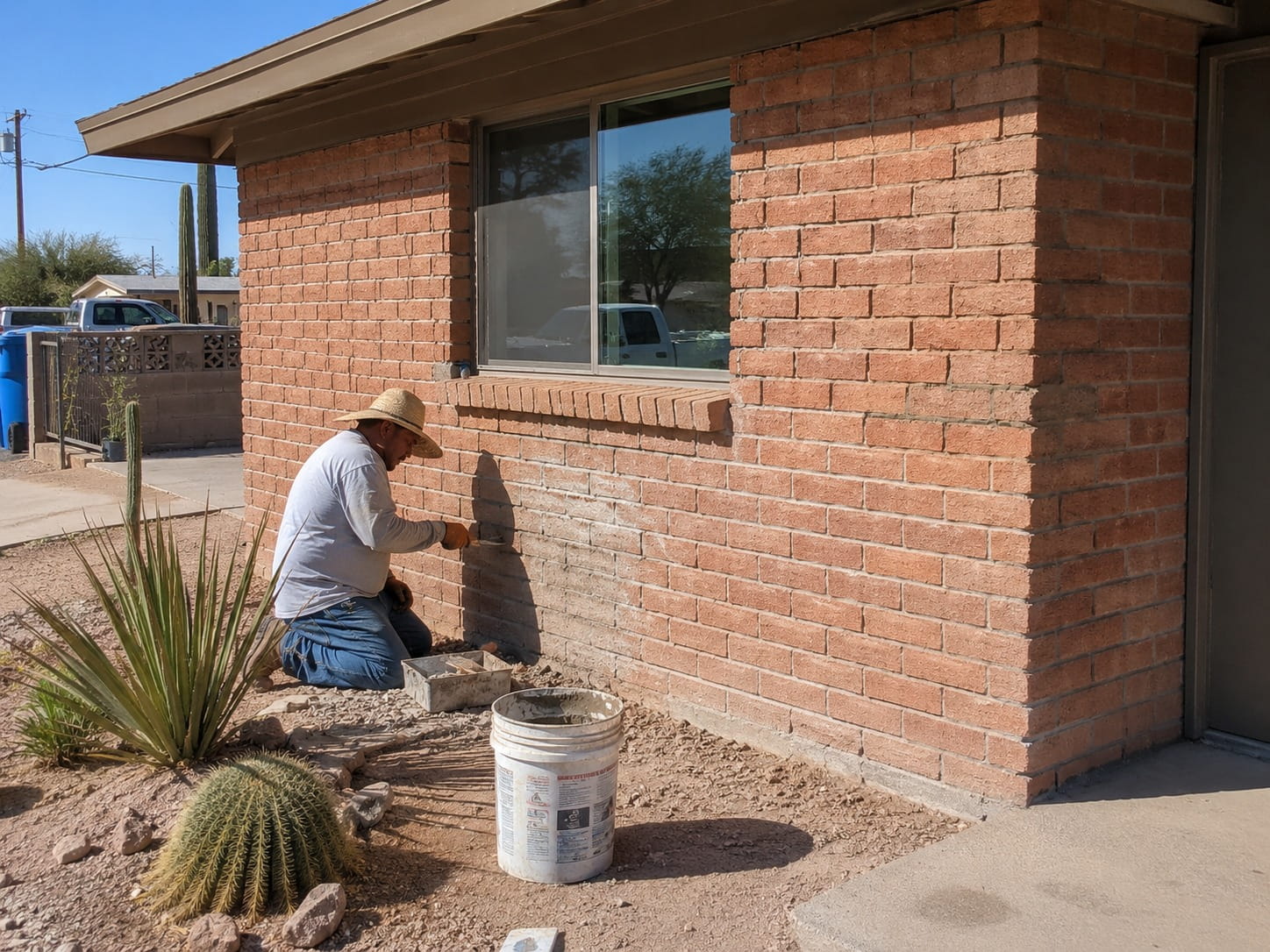
Real cost ranges for the brick masonry projects Tucson homeowners request most, plus the factors that push pricing higher or lower.
Brick Masonry Tucson Cost Guide: What to Expect in 2026
One of the most common questions we hear is some version of “what’s this going to cost?” It’s a fair question, and one that’s genuinely hard to answer with a single number, because brick masonry Tucson pricing varies more than most homeowners expect. This guide breaks down what actually drives cost so you can budget realistically before requesting quotes, and understand why two similar-looking projects can land at very different price points.
What Determines Brick Masonry Pricing in Tucson
Four factors do most of the work in determining your final price: scope (how much area needs work), condition (how much damage or deterioration already exists), access (how easy it is to reach the work area with equipment and materials), and material selection (brick grade, mortar type, and any decorative finishing). A small, easily accessible repair with minimal existing damage will always cost less than a large project with restricted access and significant pre-existing deterioration, even if both are technically “brick masonry.”
Labor also makes up a larger share of masonry costs than most people assume. Brick and mortar are relatively inexpensive on their own; the skill and time required to install or repair them correctly is where most of the cost comes from. That’s part of why rushed, underpriced jobs so often lead to problems within a few years: cutting corners on labor time is the easiest way to lower a quote, and it’s usually the first thing that shows up as a failure point later.
Typical Cost Ranges by Project Type
Brick repointing is one of the more affordable services on a per-project basis, since it targets deteriorated mortar joints rather than rebuilding the structure. Costs scale with the linear footage of joints needing attention and how much old mortar has to be carefully removed before new material goes in. If you’re seeing crumbling or receding mortar on a chimney or wall, brick repointing is usually the right service to ask about, and it’s worth catching early since small areas are far cheaper to fix than walls that have been neglected for years.
Tuck pointing sits in a similar range to repointing but often costs slightly more due to the added precision involved in creating the fine, decorative joint lines the technique is known for. If you’re restoring a historic-style facade or want a more refined finish than standard repointing provides, tuck pointing is worth the modest premium.
Brick paver patios, walkways, and driveways are priced primarily by square footage, with cost varying based on paver material, pattern complexity, base preparation, and drainage requirements. A simple running-bond patio costs less than a herringbone pattern with a decorative border, and proper base excavation and compaction (essential in Tucson’s shifting soil) adds labor time that’s easy to underestimate if you’re comparing quotes on price alone.
Block wall repair costs depend heavily on the type of damage. Repairing a few cracked or leaning sections costs far less than addressing a wall that’s failing along its full length, which sometimes points to a deeper foundation or drainage issue. If a wall on your property is leaning or has visible gaps at the base, get it assessed before the damage spreads, since block wall problems rarely stay contained to one section for long.
Foundation-related masonry work tends to be the most expensive category, simply because it involves more excavation, structural assessment, and often underpinning or crack stabilization. If you’re noticing cracks that align with foundation issues rather than surface-level brick damage, foundation repair is a separate but related service worth discussing alongside any brick work in the same area.
Repair Costs vs. New Construction Costs
Repair work is almost always less expensive than new construction, but that comparison only holds up if the repair is done correctly. A poorly executed repointing job that fails again in two years ends up costing more over time than a properly done repair that lasts fifteen to twenty years. When comparing quotes, ask what specific materials and techniques each contractor plans to use, not just the bottom-line number.
New construction, whether it’s a new paver patio or a new block wall, involves site preparation, materials, and labor across the entire footprint, which is why it typically costs more per square foot than repairing existing masonry of a similar type. That said, new construction also gives you full control over material grade, color, and design, which repair work generally doesn’t.
Getting Multiple Quotes the Right Way
It’s worth getting at least three quotes for any project beyond a small, single-area repair, but the way you compare them matters more than the number you collect. Line up each quote against the same scope: same materials, same square footage, same level of prep work. A quote that looks dramatically lower than the others often means something is being left out, whether that’s proper base preparation, adequate mortar cure time, or simply a lower labor allowance that won’t cover the time the job actually requires.
Ask each contractor to walk you through their number rather than just handing you a total. A contractor who can explain why their price is what it is, down to material grade and labor hours, is giving you more useful information than one who just quotes a round number and moves on. This is also a good opportunity to gauge how clearly a contractor communicates, which tends to predict how smoothly the actual project will go.
Hidden Costs Homeowners Often Overlook
A few line items catch homeowners off guard. Site access is one: if equipment and materials have to be hand-carried through a narrow side yard rather than driven to the work area, expect added labor cost. Existing damage discovered mid-project is another; a repointing job can occasionally reveal deeper structural issues once old mortar is removed, which changes scope. Permitting, where required for larger structural work, adds both time and cost that’s easy to forget when budgeting from an initial estimate alone.
Weather-related scheduling can also affect cost indirectly. Mortar curing during peak summer heat requires more careful handling, and monsoon season can delay outdoor work, which occasionally affects labor scheduling on larger projects. An experienced local crew builds this into their planning, but it’s worth asking about if your timeline is tight.
How to Get an Accurate Quote
The best way to get a reliable number is an in-person assessment rather than a phone estimate. Photos help, but they rarely capture the full condition of mortar joints, the extent of block wall movement, or site access challenges. If you haven’t already, read our guide on everything homeowners should know before starting a project for context on what to prepare before that visit, and check out our breakdown on how to choose the best brick masonry contractor in Tucson so you know what separates a reliable quote from an unrealistic one.
Pricing transparency matters to us, and we’d rather walk your property and give you real numbers than guess over the phone. Request a free quote and we’ll assess your specific project, explain the cost drivers that apply to your situation, and give you a clear, honest estimate before any work begins.
Ready to Build Something Lasting?
Tell us about brickwork, pavers, foundations, fireplaces, chimneys, stucco, or masonry repairs in Tucson.