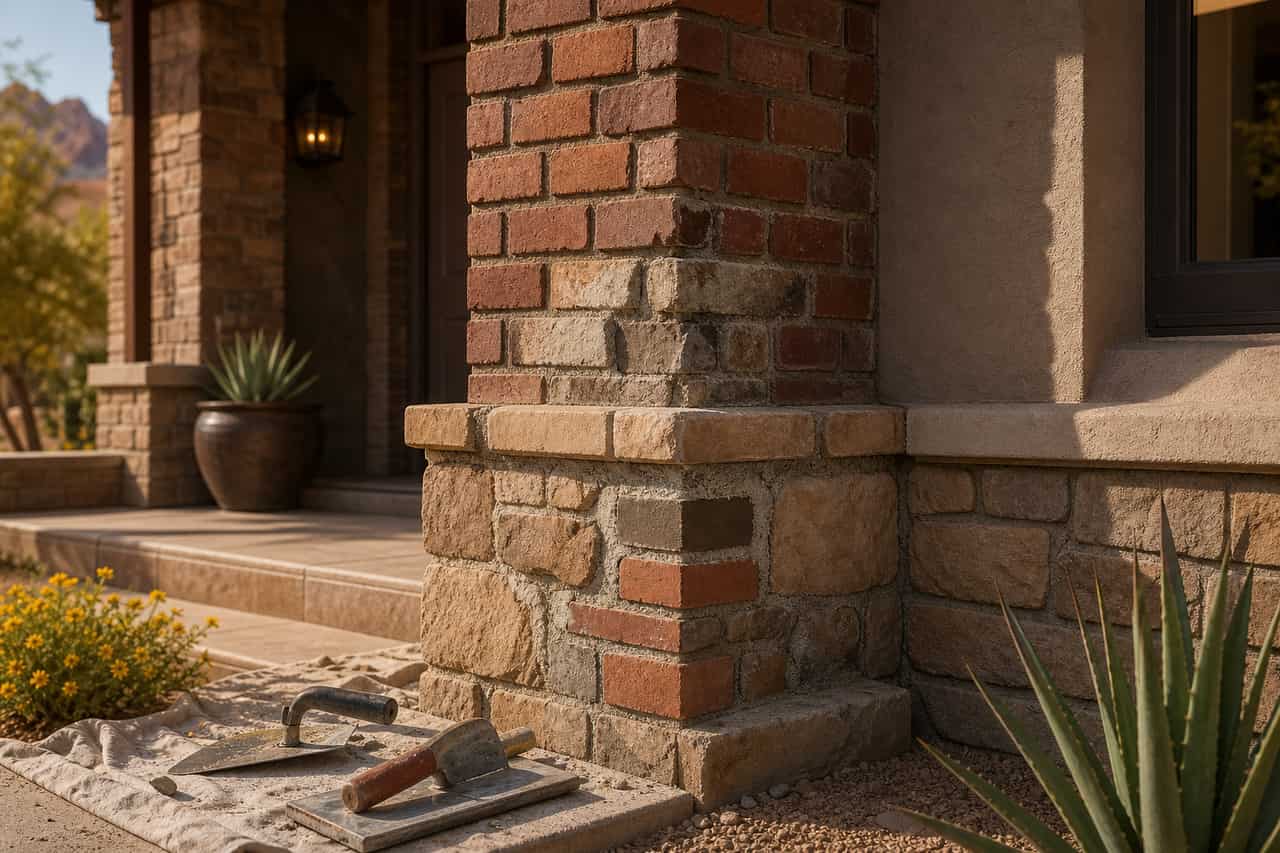
The warning signs Tucson homeowners should watch for on brick walls, chimneys, and pavers before minor damage turns into a major repair.
Brick Masonry Tucson: 10 Signs Your Brickwork Needs Professional Repair
Brick is durable, but it’s not indestructible, and Tucson’s climate gives it plenty of ways to show wear over time. Most brick masonry Tucson failures don’t happen overnight; they start small and get progressively worse until a minor fix turns into a major project. Knowing what to look for lets you catch problems early, when repairs are still simple and affordable. Here are ten signs worth taking seriously.
1. Crumbling or Receding Mortar Joints
Mortar joints are designed to wear before the brick itself does, which means visible crumbling, gaps, or joints that have receded below the brick face are actually mortar doing its job, up to a point. Once joints start failing, though, water gets behind the brick and the damage accelerates. This is the classic sign that brick repointing is due, and it’s far cheaper to address now than after several more seasons of monsoon rain work their way into the wall. On more decorative or historic brickwork, this same repair is often done as tuck pointing instead, which restores the fine, uniform joint lines rather than a purely functional patch.
2. Cracks Running Through Brick Units
Unlike mortar cracking, cracks that run through the actual brick, rather than just the joints around it, usually point to structural movement, settling, or stress somewhere in the wall. These cracks tend to follow a diagonal or stair-step pattern and shouldn’t be ignored, since they often indicate a problem that will keep spreading until the underlying cause is addressed.
3. Efflorescence (White, Chalky Staining)
That white, powdery residue you sometimes see on brick or block surfaces is called efflorescence, and it forms when water moves through masonry and deposits mineral salts on the surface as it evaporates. Occasional light efflorescence isn’t necessarily urgent, but persistent or heavy staining means water is consistently penetrating the masonry, which will eventually cause more serious damage if the entry point isn’t found and sealed.
4. Spalling Brick Faces
Spalling happens when the outer face of a brick flakes, chips, or pops off entirely, usually because trapped moisture expanded and contracted inside the brick until it broke apart at the surface. This is more than cosmetic damage; once a brick’s protective outer face is gone, the exposed interior deteriorates much faster, and spalling tends to spread to neighboring bricks over time.
5. Leaning or Bowing Walls
A wall that’s visibly leaning, bowing outward, or no longer plumb is a serious structural concern, particularly on block walls used for property boundaries and privacy fencing. This kind of movement usually indicates a foundation, drainage, or soil-related issue and calls for prompt block wall repair before the wall fails completely, which can happen suddenly once movement reaches a certain point.
6. Cracks That Align With Foundation Issues
Diagonal cracks that start near a corner or window and run upward, especially if they appear on both interior and exterior walls in the same location, often point to foundation movement rather than a simple masonry problem. If you’re seeing this pattern, it’s worth having both the brickwork and the foundation assessed together, since foundation repair may need to happen before any surface-level brick repair will actually hold.
7. Loose or Missing Bricks
A brick that wiggles when pressed, or a gap where one has already fallen out, means the surrounding mortar has failed enough that the brick is no longer properly anchored. This is both a safety hazard, especially at head height near walkways, and a sign that the surrounding area likely has additional hidden mortar deterioration that isn’t yet visible.
8. Visible Gaps Between Brick and Window or Door Frames
Small gaps that open up between masonry and the frames of windows or doors often indicate settling or thermal movement that’s pulling the two materials apart. Left unaddressed, these gaps become entry points for water and pests, and they tend to widen gradually rather than resolve on their own.
9. Discoloration or Dark Staining Patterns
Dark streaking or discoloration, particularly beneath windowsills, chimney caps, or wall copings, usually indicates water is running down the face of the masonry from a point where it shouldn’t be getting in. Tracing the staining back to its source, often a failed cap, damaged flashing, or a cracked coping stone, is key to fixing the actual problem rather than just the visible symptom.
10. A Chimney or Wall That Feels “Off” Compared to Before
Sometimes the sign isn’t a specific defect but a general sense that something has changed: new cracks that weren’t there last year, a section of wall that looks different after a hard monsoon season, or a chimney that seems to lean slightly more than you remember. Trust that instinct. Brick and block deterioration is often gradual enough that a professional eye catches changes homeowners have slowly grown used to seeing.
How Quickly Should You Act on These Signs
Not every sign on this list demands an emergency call, but the general rule is that masonry problems get more expensive the longer they sit. Mortar issues that would cost a few hundred dollars to repoint today can turn into brick replacement or structural repair if water keeps working its way into the wall for another two or three monsoon seasons. Leaning walls and structural cracking are the exceptions that do warrant prompt attention, since these can progress from a manageable repair to a full rebuild, or a safety hazard, in a relatively short window.
A good rule of thumb: if you can point to a specific area of concern and describe when you first noticed it, that’s usually a sign it’s been developing for a while and is worth having looked at soon rather than added to a someday list.
Brick or Stone: Does the Repair Material Matter?
If you’re dealing with repeated brick issues, it’s worth understanding how brick compares to stone construction in terms of long-term durability in Tucson’s climate. We cover this in detail in our guide on brick versus stone for Tucson homes, which can help inform your decision if you’re considering a larger repair or rebuild rather than a targeted fix.
When to Call a Professional
Any one of these signs on its own might not be an emergency, but ignoring several at once, or letting a known issue sit for multiple seasons, is how small repairs turn into full wall reconstructions. Tucson’s combination of intense heat, UV exposure, and monsoon rain gives masonry problems more opportunities to worsen quickly than in milder climates.
If you’ve spotted one or more of these warning signs on your property, don’t wait for it to get worse. Schedule an inspection with our team, and we’ll give you an honest assessment of what’s happening, what it will take to fix it, and how urgent the repair actually is.
Ready to Build Something Lasting?
Tell us about brickwork, pavers, foundations, fireplaces, chimneys, stucco, or masonry repairs in Tucson.